How to Train Restaurant Staff on Wine (Without Overwhelming Them)
Most restaurant wine training loads staff with knowledge they can't use under pressure. Here's what actually builds confidence on the floor — and how to do it in under two minutes.
The wrong model
The standard approach to wine training assumes that knowledge creates performance. Learn enough about the wines, and the words will come when you need them. Understand the regions, the grapes, the production methods — then confidently recommend.
On paper that makes sense. On a floor with forty covers and a printer going off every ninety seconds, it falls apart completely.
The environment where training happens and the environment where behaviour is expected are completely different. A tasting room is calm. The table is not. A classroom has no time pressure. The moment a guest looks up from the menu and says "what do you recommend?" has about four seconds of grace before it gets awkward. Staff trained in calm conditions often freeze in live ones — not because they forgot the information, but because the gap between knowing and saying is wider than the training addressed.
Knowledge does not create confidence. Language does.
The staff member who hesitates at the table is not blanking on the wine. They are blanking on what to say. They know the wine is good. They have no reliable phrase to lead with. The tasting they attended two weeks ago gave them a lot of adjectives and no architecture for the conversation.
What actually works
Effective wine training for a floor team is not about depth of knowledge. It is about depth of repetition on a small number of useful things.
Three things that a server genuinely knows how to say, delivered calmly and consistently, will produce more wine revenue than a staff member with encyclopaedic wine knowledge who freezes when it counts. The narrow target is the point.
This means the training focus should not be "teach the wine list." It should be "install two or three phrases that work in the specific moments where wine revenue is won or lost." The first thirty seconds at a table. The moment a guest hesitates over the list. The moment someone says yes and the server needs to close it cleanly.
Those moments are predictable. They happen every service. Preparing for them specifically — with exact language rather than general knowledge — is what changes behaviour.
How to run it in pre-shift
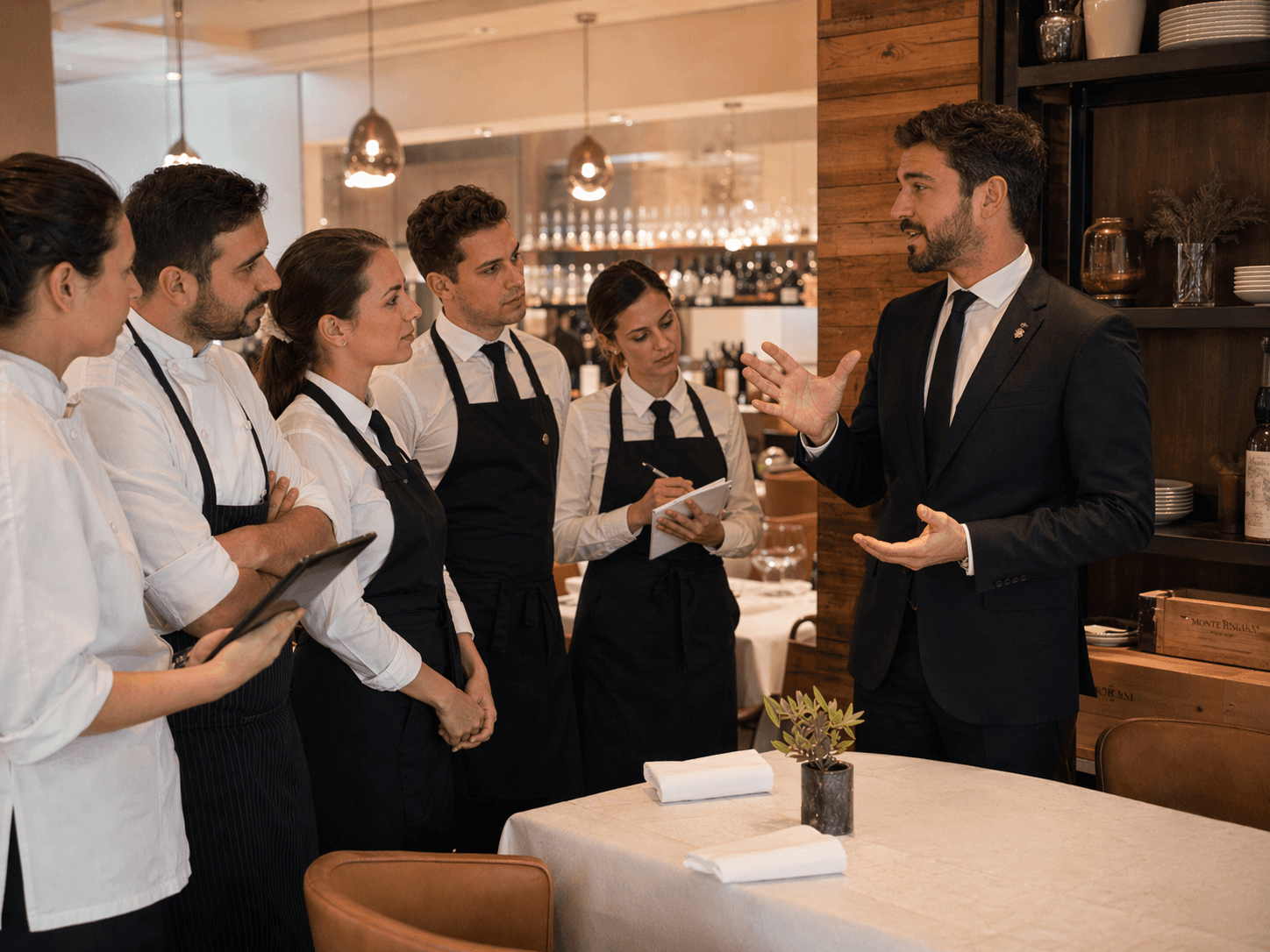
The pre-shift briefing is the most underused training tool in any restaurant. Most managers use it for logistics and motivation. The ones who run tight operations use it for micro-training: one behavioural target, one piece of exact language, one rep before service starts.
The structure is simple.
Name the skill in ten seconds. Not the category — the specific thing. "Tonight's focus is the first wine suggestion at the table." Tell the team exactly what moment they are training for.
Install the exact language in twenty seconds. Not a description of what to say — the actual words. "When someone looks uncertain, say: 'Are you thinking red or white, or would you like me to point you somewhere?' Then wait." Give them the sentence. Not a framework. Not guidance. The sentence.
Run one rep in under a minute. Pair up. One person is the server, one is the guest. Thirty seconds. They say the line, in the room, out loud, before service. That is what makes it stick. Hearing yourself say something once in a low-pressure environment reduces the friction of saying it the first time at a table.
Set the expectation in fifteen seconds. "Everyone uses this once tonight. I'll follow up at the end of service." That last line matters. It signals the training is not finished when the briefing ends — it is being watched. Accountability changes how things are approached.
That is ninety seconds. It is repeatable every shift on a rotating focus. And because each session targets one thing rather than twelve, the cumulative effect after two or three weeks is a team with consistent, comfortable language across the key moments in wine service.
What to leave out of pre-shift
Wine tastings are not pre-shift training. Blind tastings, region reviews, food pairing discussions — all of these have value, but they belong in a scheduled session with time to actually process the information. Trying to run them in the five minutes before service starts produces the worst of both: rushed information the team cannot absorb, and a pre-shift that overruns and starts service behind.
The same applies to any wine training that is primarily informational. If the goal is to teach staff about a new addition to the list, the pre-shift is the wrong place for it. Tell them what it is, give them one line about it, and move on. The detail can go in a written handout, a tasting note card kept on the floor, or a scheduled training session.
Pre-shift is for direction. The rule is simple: if it cannot be said in under two minutes and immediately applied in service, it is not pre-shift material.
Reinforcement on the floor
Training that happens in the briefing and never gets followed up dies quickly. The team uses the phrase twice, it feels awkward, nobody says anything, and they quietly stop.
The manager's job during service is to catch moments of good execution and name them. Not a big production — just a passing comment. "That table in section B, that's exactly what we were talking about." Thirty seconds. It tells the team that the training was real, not just words before the shift.
It also helps to close the loop at the end of service. Not a debrief — just a question. "Who used the wine line tonight? How did it land?" Two or three responses. Done. The team sees that what happens in pre-shift connects to what happens on the floor and gets reviewed at the end. That loop — brief, execute, review — is what turns one-off training into actual habit.
The reinforcement problem most teams have
The most common failure in wine training is not the initial session. It is what happens after.
A manager runs a solid tasting. The team is engaged. There is a clear improvement in wine conversation that service. By the following week, the gains are gone. Nothing was reinforced. New services brought new pressures. The language that was not embedded deeply enough got crowded out.
Improvement compounds through repetition, not volume. Running the same focus three services in a row — same language, same expectation, same brief review — builds something that holds under pressure. Rotating topics every shift so that "everyone gets covered" does the opposite. Staff learn to wait it out. They know it will change tomorrow.
The discipline is to resist the urge to add more. One skill at a time. Drive it until it is consistent. Then move to the next.
The commercial case
A team that can have a comfortable, natural wine conversation at the table makes more money than a team that has been to more tastings but freezes when it counts. The gap between those two is not knowledge. It is language — reliable, practised, used often enough that it requires no effort to retrieve under pressure.
That is trainable. It does not require expensive programs, outside specialists, or hours of time pulled from operations. It requires a different approach to the two minutes before service starts, run consistently, with the expectation that behaviour on the floor will reflect it.
That expectation, set clearly and followed through, is most of the work.
One Better Glass covers the exact language for wine service moments — the first thirty seconds, the hesitant guest, the upsell, and the close. Built for floor teams, used in pre-shift. Available at The Glass Pour.
Pre-Shift Notes — one short note each week on wine, service, and standards. Subscribe below.